
A Guide to Commercial Collagen Supplements: Types, Absorption, Bioavailability, and Use
Types of Commercial Collagen Supplements
Commercial collagen supplements vary based on their animal source, processing method, and the specific type of collagen they contain. The most common types available on the market include:
1. Hydrolysed Collagen (Collagen Peptides)
Source: Derived from cow (bovine), pig (porcine), chicken, or fish (marine) skin, bones, or scales.
Processing: The collagen protein is broken down into smaller fragments (peptides) through hydrolysis, making it easier to dissolve in liquids.
Type Content: Predominantly Type I and III (bovine, marine), Type II (chicken sternal cartilage).
Form: Powder, capsules, or drinks. Easily mixed into beverages and foods.
Use: General support for skin, hair, nails, joints, bones, and gut health.
2. Undenatured Collagen (UC-II)
Source: Usually derived from chicken breast cartilage.
Processing: Not hydrolysed, the collagen remains in its native (undenatured) triple-helix form.
Type Content: Type II collagen.
Form: Capsules or tablets.
Use: Specifically targeted for joint health, especially in osteoarthritis and rheumatoid arthritis.
3. Gelatin
Source: Similar animal origins to hydrolysed collagen.
Processing: Partially hydrolysed (not as broken down as peptides). Forms a gel when mixed with hot liquid.
Type Content: Predominantly Types I and III.
Form: Powder, sheets, or culinary gels.
Use: Food preparation (jelly, gummies), with some minor benefits for skin and joints.
4. Marine Collagen
Source: Fish skin, scales, or bones.
Processing: Typically hydrolysed for high solubility.
Type Content: Mostly Type I collagen, which is abundant in skin and bones.
Form: Powder, capsules, or drinks.
Use: Popular in beauty supplements due to small particle size and high bioavailability (see below).
5. Bovine Collagen
Source: Cow hides and bones.
Processing: Either hydrolysed or used as gelatin.
Type Content: Types I and III collagen.
Form: Powders, capsules.
Use: General structural protein support for skin, hair, bones, and joints.
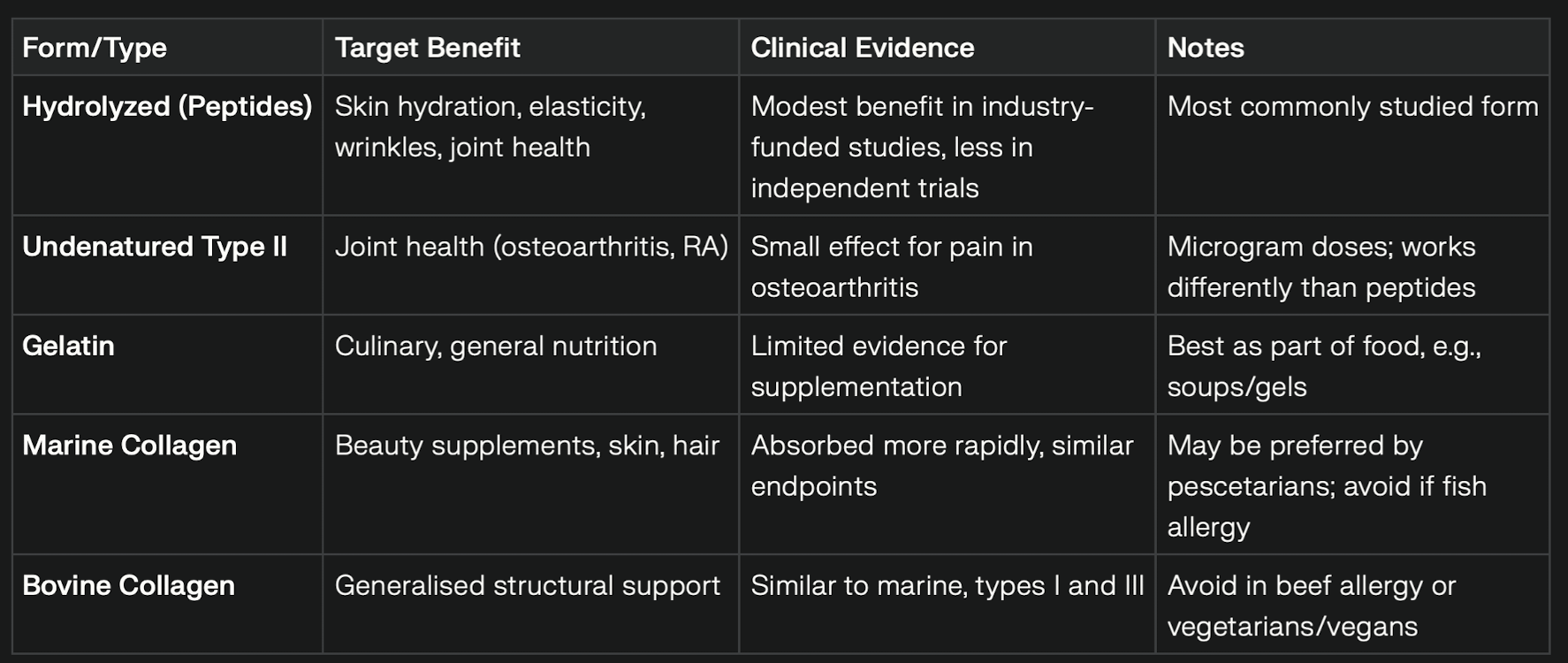
The market offers a variety of collagen supplements, distinguished primarily by their animal source, processing method, and type of collagen they provide. Hydrolysed collagen peptides are the most prevalent form, produced by breaking down animal-derived collagen into smaller peptide fragments. These peptides are highly soluble and can be mixed into drinks or foods, predominantly featuring types I and III (from bovine and marine sources) or type II (from chicken cartilage). Undenatured collagen (UC-II) is a less processed option, containing native type II collagen usually extracted from chicken breast cartilage; it remains in its triple-helix form and is marketed primarily for joint health. Gelatin is another form, only partially broken down and commonly used in cooking rather than supplementation, forming a gel when heated. Marine collagen, sourced from fish skin, scales, or bones, is almost always hydrolysed and prized for its smaller particle size and type I content, often used in beauty supplements. Bovine collagen is a more general-purpose product, sourced from cow hides and bones, and provides types I and III collagen for skin, hair, bones, and joints.
Key Takeaways
Hydrolysed collagen peptides (including marine, bovine, and porcine sources) are the most studied, best absorbed, and most widely available commercial collagen supplements.
Undenatured type II collagen is used in much smaller doses specifically for joint health and works by a different (immunomodulatory) mechanism.
Marine collagen generally offers higher bioavailability due to a smaller particle size.
All types are ultimately digested into peptides and amino acids before absorption; the body uses these based on need, not by supplement type.
Real-life benefits appear modest for most uses, with the best evidence for mild joint pain and minor improvements in skin hydration, primarily in studies funded by the collagen industry.
How Collagen Supplements Are Absorbed in the Body
No matter the source or form, collagen supplements cannot be absorbed directly in their whole, intact state. The body digests these proteins through the action of stomach acid and digestive enzymes, breaking them down into shorter peptides (sequences of amino acids, which can be thought of as link chains) and individual amino acids. Hydrolysed collagen, which is pre-broken into peptides, is absorbed more efficiently than gelatin or native (undenatured) collagen, as its smaller fragments pass more readily through the gut wall into the bloodstream. Once in circulation, the body utilises these building blocks wherever they are needed for repair and maintenance, not just in the skin or joints, but in any tissue that requires new protein synthesis.
“All types [of collagen] are ultimately digested into peptides and amino acids before absorption; the body uses these based on need, not by supplement type.”
Bioavailability of Different Collagen Types
Bioavailability refers to the amount of a nutrient that is absorbed and made available for use by the body, and it varies between different types of collagen. Hydrolysed collagen peptides offer the highest bioavailability, as their smaller molecular size enables quicker, more effective absorption. Marine collagen stands out for even greater bioavailability. Its peptides, typically of a smaller molecular weight than those derived from bovine or chicken sources, are absorbed up to 1.5 times more efficiently. However, marine collagen is extracted from fish waste (Skin, scales, bones, skull, swimming bladder, and remaining viscera — all the stuff the fish industry could not monetise before. Now it’s making billions out of fish waste). Unless it is analysed for contaminants at every stage of the processing, it is very likely to be ultra-contaminated by heavy metals, microplastics and other toxins.
Undenatured collagen is poorly absorbed in its native form and, when used therapeutically, is typically administered in minuscule doses to modulate the immune response in joints rather than to provide bulk protein.
Gelatin falls in between: it is more bioavailable than native collagen but less so than hydrolysed peptides, making it more suitable for culinary rather than clinical purposes. Bioavailability can also be influenced by the health of the digestive system, with individual differences in gut function affecting the absorption of collagen peptides.
“There is little solid proof collagen will survive digestion, travel into the bloodstream and make it to your skin. In fact, when any protein arrives in the stomach – including collagen – it is usually swiftly broken down into amino acids, which are then reassembled into the proteins that the body needs at that moment. So, if the body needs collagen, it might reassemble those amino acids into collagen, but there are no guarantees.”
Uses and Clinical Applications
Each form of commercial collagen serves slightly different purposes, depending on its processing and type. Hydrolysed (peptide) collagen is the most studied and versatile, with some evidence (mainly from industry-funded studies) suggesting modest benefits for skin hydration, elasticity, and the appearance of wrinkles, as well as possible support for joint comfort in osteoarthritis.
Undenatured type II collagen (UC-II), used in small amounts, has been shown in some research to provide modest relief from joint pain and improve function in individuals with osteoarthritis or rheumatoid arthritis, possibly by helping to regulate immune activity in the joints.
Gelatin is more commonly used as a food ingredient to add texture to dishes; its health benefits for joints and skin are less substantial, although it can still provide amino acids necessary for overall tissue repair.
Marine collagen is favoured in beauty products for its rapid absorption and purported benefits for skin, hair, and nails; however, as with other types, the clinical benefits remain modest when scrutinised in high-quality, independent studies. Bovine collagen is a general supplement that supports various connective tissues; however, it is unsuitable for vegetarians or vegans.
There is also the emergence of nano collagen, which is a new way of administrating collagen in wound healing. It is unlikely it will be included in the food chain.
What About Vegan Collagen?
Strictly speaking, there is no true vegan collagen available on the commercial supplement market. All naturally-occurring collagen is produced by animals. Extracting collagen from plant sources is not possible because plants simply do not make collagen. Therefore, traditional collagen supplements are inherently not vegan or vegetarian-friendly.
“Collagen is only found in animal connective tissue.
Some plant-based supplements claim to be ‘vegan collagen’, but what they actually contain are collagen-boosting ingredients like vitamin C, amino acids and minerals that help your body make its own collagen. If you’re vegan, you might want to spend your money on a well-rounded diet instead of plant-based ‘collagen’ supplements that don’t actually contain collagen.”
What Are “Vegan Collagen” Products?
Products marketed as “vegan collagen” or “plant-based collagen boosters” do not contain actual collagen. Instead, they fall into two general categories:
1. Collagen Boosters or Builders, “Pro Collagen”
These supplements provide nutrients that support the body’s own collagen production, such as:
Vitamin C (essential for collagen synthesis)
Amino acids (often sourced from plants, especially glycine and proline)
Zinc, copper, and sometimes silica (essential cofactors)
Botanicals (like aloe vera, bamboo extract)
Such products may be referred to as “collagen builders,” “collagen-support blends,” or “vegan collagen support.” They support the body’s existing processes but do not deliver collagen itself.
2. Fermented or “Bioidentical” Collagen
Recent technological advances have allowed some companies to produce what they call “animal-free” collagen by using genetically engineered yeast or bacteria. These microbes are programmed to produce a protein with an amino acid sequence identical to that of human collagen through fermentation. While promising, these laboratory-produced bioidentical collagens are not widely available in consumer supplements. They are mainly used in research or high-tech applications (like lab-grown meat or medical materials).
How Do Vegan Collagen Alternatives Work?
Boosters: By providing key ingredients required for collagen synthesis, vegan products may help the body optimise natural collagen production if your diet is lacking in those ingredients.
Bioidentical Collagen: Although theoretically equivalent to animal collagen, human clinical trials for bioidentical “vegan collagen” are still limited, and commercial products are not yet widely available in stores.
Effectiveness: Can You Get the Same Results?
Actual collagen structure: Plant-derived supplements can never provide real collagen directly, only the nutrients your cells need to make it.
Clinical evidence: To date, no studies have shown that “vegan collagen” boosters or blends match the possible (if modest) effects seen with animal-based collagen peptides in improving skin hydration, elasticity, or joint comfort.
Diet still matters most: A balanced, plant-rich diet with adequate protein, vitamin C, zinc, and copper remains the foundation for healthy collagen synthesis in vegans and vegetarians.
Also, remember that anything affecting digestion, such as stress (including chronic stress, anxiety, and depression), infection (including colds, flu, and H. pylori), gut dysbiosis, low-grade gut inflammation, and dysfunction of the liver, pancreas, and bile system, will affect how you digest food (breakdown and absorb protein).
Collagen in Functional Foods: Hype vs. Evidence
Functional foods are everyday items (e.g., snack bars, meal-replacement shakes, coffee creamers, yoghurts, and even bottled waters) marketed with added health-promoting ingredients such as vitamins, minerals, probiotics, or, increasingly, collagen peptides. In the UK and globally, you’ll now find collagen promoted in protein bars, breakfast cereals, flavoured drinks, and more, all claiming to support skin, joint, hair, or even gut health.
Note: Functional foods are foods that provide health benefits beyond basic nutrition, thanks to naturally occurring or added components that can promote well-being or help reduce the risk of certain diseases.
— Why Add Collagen to Functional Foods?
Food manufacturers add collagen mainly for its trend appeal and marketing value. The goals are to:
Tap into consumer interest in “beauty from within” and joint/ageing health
Offer a perceived “boost” alongside convenient snacking or daily routines (e.g., powders designed to be added to coffee, claiming to help you “start your day with beauty peptides in your coffee”)
Differentiate products in a crowded wellness market
— How Much Collagen Is in These Products?
Most functional foods contain smaller amounts of collagen (often 2–5 g per bar, drink, or serving) compared to the 5–10 g doses studied in supplement trials. The type is usually hydrolysed peptides from bovine or marine sources. However, the dose is so minimal, it will offer no benefit whatsoever beyond the amino acid profile that will be used by the body, mainly for healing and repair of any tissue, or to build enzymes and (protein) hormones. Examples of major protein hormones include insulin, glucagon, growth hormone, follicle-stimulating hormone (FSH), oxytocin, and vasopressin.
— Scientific Evidence: Are Claims for Functional Foods Justified?
The clinical evidence is even weaker for functional foods than for standalone collagen supplements:
Virtually all studies examining skin or joint benefits are based on purified collagen supplements, not products mixed with sugar, fats, or other food ingredients.
The typical serving size of collagen in functional foods often falls below the minimum used in positive supplement trials, making significant systemic effects unlikely.
Fats, fibres, sugars, and heat processing can alter the absorption or effectiveness of collagen peptides.
Added vitamins (like vitamin C) might, in theory, help collagen synthesis, but there’s no direct evidence that combinations in bars or drinks are more effective than standalone collagen.
Regulatory oversight for claims in functional foods is also limited; many health benefits touted on packaging are based on ingredient association, not real clinical outcomes.
— What Does This Mean for Consumers?
Buying a high-sugar or high-calorie “functional” snack because it contains collagen is unlikely to result in meaningful changes to skin or joint health. It may exacerbate any inflammatory disorder and gut dysbiosis (especially in individuals following a sugar-based or ultra-processed diet)
For the best chance of seeing any potential effect, hydrolysed collagen should be consumed in clinically studied doses, consistently, and as part of a diet that already meets other nutritional needs. Although long-term dosage and benefits have not been proven.
Functional foods with added collagen may serve as a convenient protein boost, but any claimed systemic benefits for beauty or joints remain unsupported by independent science.
Source:
BBC.co.uk
Arhritis Foundation
References:
Fu, Y. Therkildsen, M. Aluko, RE. et al. (2018). Exploration of collagen recovered from animal by-products as a precursor of bioactive peptides: Successes and challenges. Critical Reviews in Food Science and Nutrition. 59(13), pp. 2011-2027. doi:10.1080/10408398.2018.1436038
Gelse, K. Pöschl, E. Aigner, T. (2003). Collagens--structure, function, and biosynthesis. Advanced Drug Delivery Reviews. 55(12), pp. 1531-1546. doi:10.1016/j.addr.2003.08.002
Honvo, G. Lengelé, L. Charles, A. et al. (2020). Role of collagen derivatives in osteoarthritis and cartilage repair: A systematic scoping review with evidence mapping. Rheumatology and therapy. 7(4), pp. 703-740. doi:10.1007/s40744-020-00240-5
Martínez-Puig, D. Costa-Larrión, E. Rubio-Rodríguez, N. (2023). Collagen supplementation for joint health: The link between composition and scientific knowledge. Nutrients. 15(6), 1332. doi.10.3390/nu15061332
Pu, SY. Huang, YL. Pu, CM. et al. (2023). Effects of oral collagen for skin anti-aging: A systematic review and meta-analysis. Nutrients. 15(9), 2080. doi:10.3390/nu15092080
Shoulders, MD. Raines, RT. (2009). Collagen structure and stability. Annual Review of Biochemistry. 78, pp. 929-958. doi:10.1146/annurev.biochem.77.032207.120833